How to choose a high-quality high-pressure hose for a car wash machine?
When selecting high-quality washing machine high-pressure hoses, one must consider various factors such as material, rated pressure, inner diameter, length, and surface roughness of the inner hole. High-pressure hoses come in various materials; for example, PVC is commonly used for household purposes, while steel wire-braided hoses are often used for commercial applications. The rated pressure of the hose must be greater than the rated pressure of the washing machine to prevent reducing the lifespan of the rubber hose. The inner diameter should be chosen in conjunction with the flow rate, the length should be minimized to reduce pressure loss, and the surface of the inner hole should be smooth. By considering these key points, one can select high-quality high-pressure hoses.
Let’s start by discussing the materials. PVC high-pressure hoses are affordable and lightweight, making them suitable for household car washes. Under normal use, they can last over 10 years and possess good corrosion and abrasion resistance. Steel wire-braided hoses, on the other hand, are primarily used for commercial applications. They are extremely durable and resistant to pressure, but they are heavier and have higher maintenance costs for connections.
Regarding the rated pressure, this is of utmost importance. The rated pressure of the high-pressure hose must be equal to or greater than the rated pressure of the high-pressure pump. Once the pressure in the pump exceeds the rated pressure of the hose during operation, the lifespan of the hose will be significantly reduced. If it exceeds one-quarter of the rated pressure, the lifespan of the hose may even be halved, and there is a risk of expansion and rupture at joints and other areas.
The selection of the inner diameter also requires careful consideration. It must balance the pressure loss within the pipe with the frictional resistance between the pipe and the bottom surface of the larger pipe outside. A larger inner diameter results in smaller pressure loss and greater jet impact force, but also increases frictional resistance and reduces the self-propagation distance of the nozzle. Generally, for flows below 50 L/min, choose a high-pressure pipe with an inner diameter of 6 mm; for flows between 60 and 90 L/min, choose one with an inner diameter of 10 mm; and for flows above 100 L/min, choose a pipe with an inner diameter of 13 mm or larger.
As for the length, the length of the high-pressure hose is closely related to pressure loss and the impact force on the nozzle. The shorter the length, the lower the pressure loss and the greater the impact force on the nozzles. Therefore, in actual operations, it is essential to minimize the length of the high-pressure hoses, and only consider using longer hoses for long-distance cleaning.
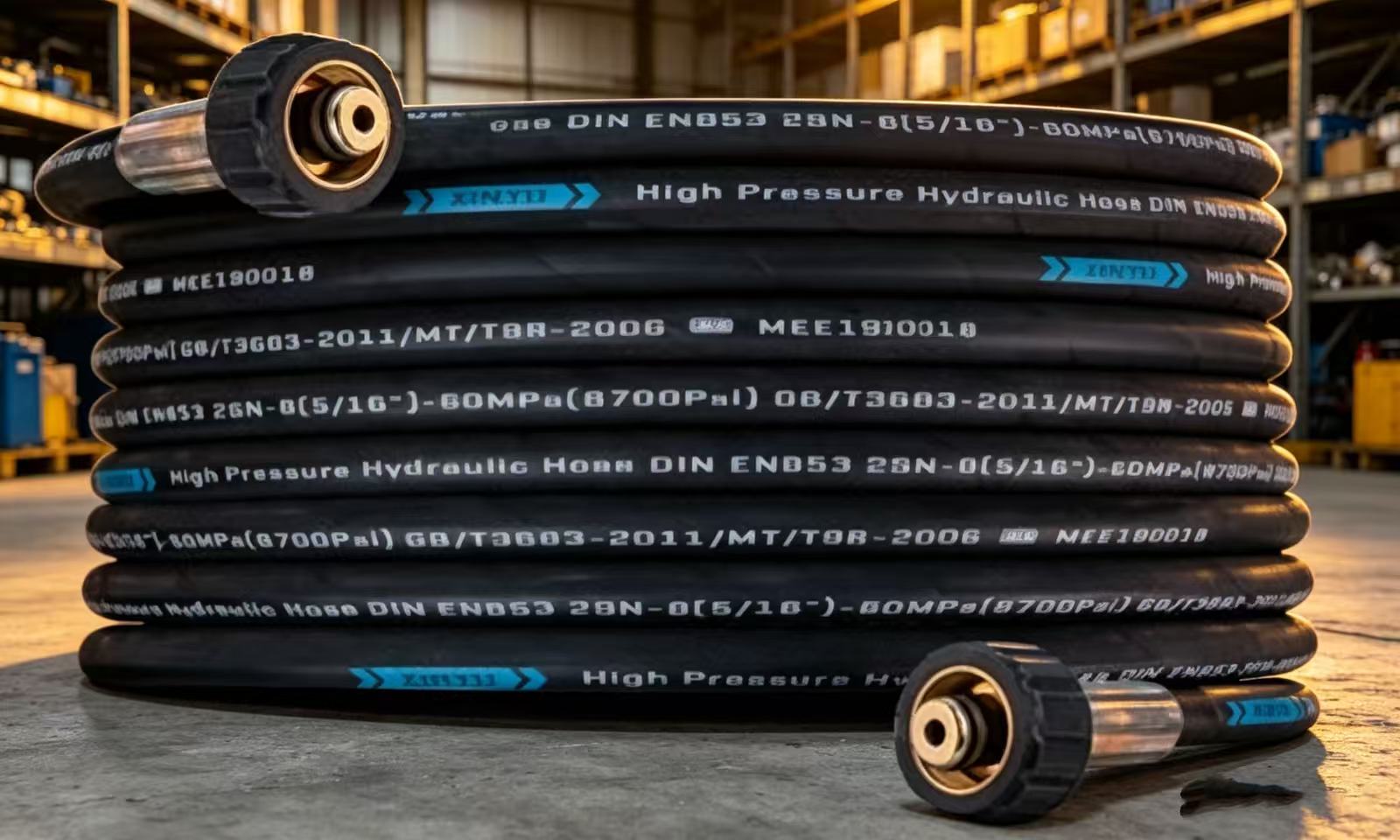
The surface roughness of the inner hole surface is also crucial. The degree of smoothness of the inner layer material in high-pressure pipes varies, such as rubber, nylon, and polyamide. The higher the roughness and friction coefficient, the greater the pressure loss. To increase the impact force at the nozzle outlet, it is essential to select high-pressure pipes with smooth inner surfaces.
In summary, when selecting a high-pressure hose for a car washing machine, it is essential to comprehensively consider factors such as material, rated pressure, internal diameter, length, and surface roughness of the inner hole. By taking these factors into account, you can choose a high-quality hose that suits your needs, making the car washing process easier and more efficient.