
Want to build your own car washing machine, but having trouble assembling the pump head?
Many of my friends have a motor they want to pair with a separate pump head, but they’re unsure of how to choose one. They wonder what type to select, including the quality, to ensure the cleaning machine is durable. Today, we’ll teach you how to choose a pump head that is durable and suitable for you.
Let’s start by discussing the quality aspect. The quality of the pump head depends on the material of the plunger, the material of the water seal and oil seal, and the size of the copper block.
If the motor’s power is high, then the copper block you choose for the pump head must be thick. This way, it will be more resistant to pressure and less likely to leak.
Regarding the material of the plunger, if the cleaning machine is intended for commercial use, it is essential to choose a ceramic plunger. Ceramic plungers have a relatively smooth surface and a special material that provides resistance to corrosion, wear, and high temperatures. Therefore, if used in car wash shops or livestock farms, it is advisable to opt for ceramic plungers. For household use, where the frequency of use is not high, a ceramic-coated plunger can be chosen. Ceramic-coated plungers are relatively inexpensive, making them a more cost-effective option.
Next are the water seals and oil seals. There are rubber seals and fabric-reinforced seals. Generally, fabric-reinforced seals are more commonly used in the market today because they can resist the invasion of microorganisms.
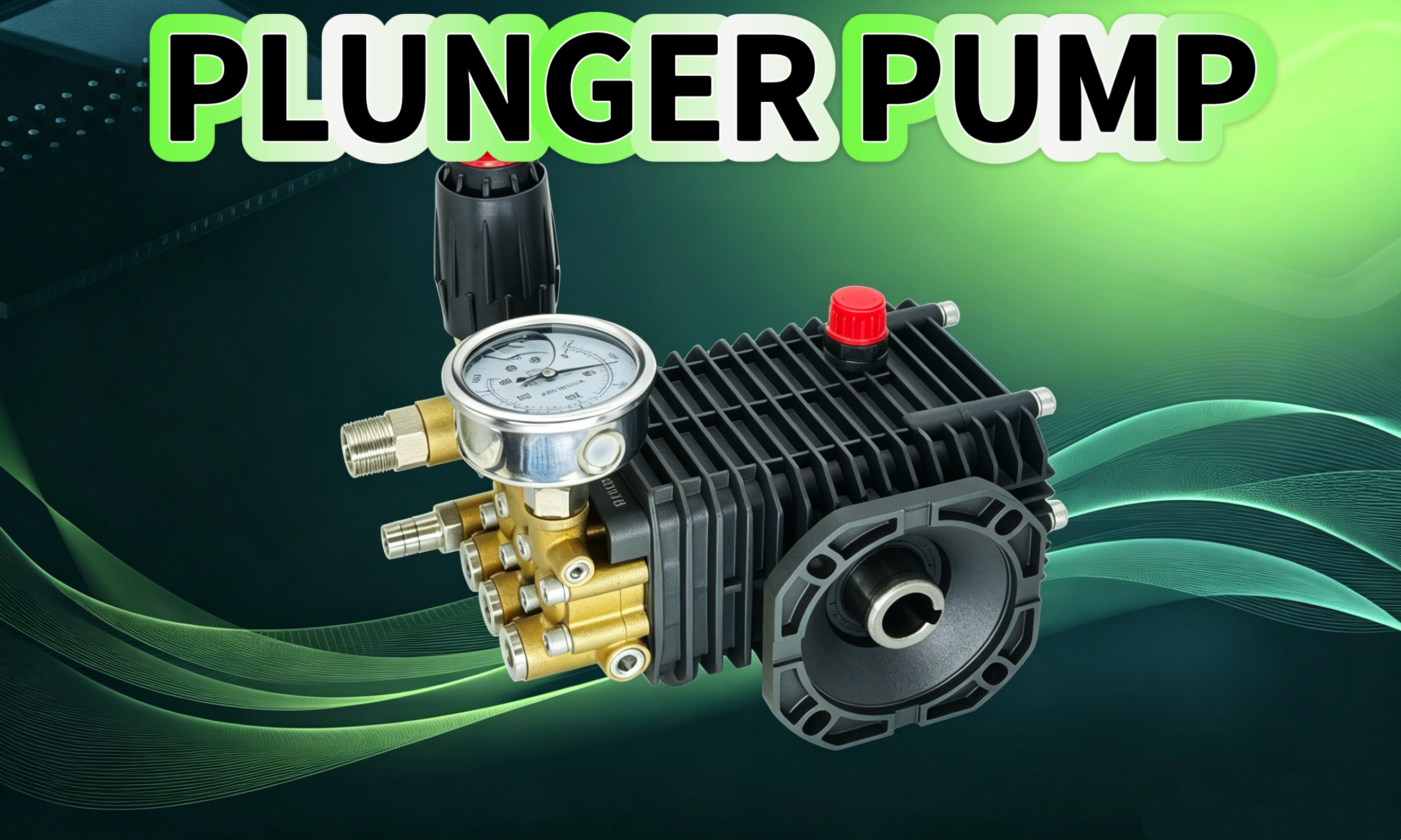
Next is the size of the copper block. If the motor’s power is relatively high, including motors with four phases or three-phase power, we will definitely need to choose pumps with larger copper blocks to minimize the risk of water leakage.
There are many types of pump heads available, such as the 14-solenoid series, the 16-solenoid series, and the 20-solenoid series. With so many series to choose from, how can we select the most suitable one? Firstly, we need to determine the power of our motor. If the motor has a higher power, we can choose a larger pump head that can handle greater pressure and flow rates. However, there’s an important point to note: the motor determines pressure, while the pump head determines flow rate. If your motor’s power is only 2 kilowatts, but you want to use a larger pump head that can fit within the spacing of the flange bearing screw holes, then as the flow increases, the pressure will naturally decrease. Therefore, it’s essential to match the appropriate motor with the appropriate pump head to achieve our desired results.
As for our motors, there are also many different types. For example, our plug-in motors have 220-volt household use, 380-volt commercial use, and diesel and gasoline engines. These motors are suitable for different types of pump heads as well. Additionally, we have 2,800-RPM second-stage motors and 1,400-RPM fourth-stage motors for plug-in use, which are also suitable for different pump heads. Overall, motors can be categorized into second-stage and fourth-stage motors, 220-V household use and 380-V commercial use, with external and internal shafts, each of which is suited for different applications. For example, this pump shaft is an internal shaft pump head, while this pump shaft is an external shaft pump head. Typically, external shaft pump heads are used with motor bases. Let me give you an example. A 3-kW motor rated at 220 volts can be used with a 1812 pump head, a 1814 pump head, or a 2012 pump head. Therefore, these pump heads can be used in various scenarios, depending on what you need. For instance, if you run a farm, you’ll likely want a higher pressure and sufficient flow rate. So, if you use a 3-kW motor for a farm, I would recommend choosing a 1812 pumphead to ensure sufficient flow and pressure. If you run a car wash, I suggest opting for a pumphead with higher flow rate to improve efficiency. The pricing will depend on what you can afford.
Next, there’s a type of pump head that’s quite special: the stainless steel pump head. Some customers ask why stainless steel pump heads are so much more expensive than pure copper pump heads. For example, a 1812 pump head made of copper costs around 700 yuan. However, if you want to use stainless steel, the price is at least twice that of the copper pump head. This is because stainless steel pump heads are more resistant to corrosion and wear. Such pump heads are generally suitable for use with caustic soda, hot water, or water with high corrosiveness. Customers who clean kitchen hoods, as well as those in animal husbandry who need to disinfect with caustic soda, typically use stainless steel pump heads. Even for those working in maritime environments with dirty or highly corrosive water sources, stainless steel pump heads are preferred. For instance, if you need to use caustic soda, a copper pump head might last around 3 to 6 months before the pump head leaks and the internal components are corroded. In contrast, a stainless steel pump head can last at least 3 years or more. Therefore, I also suggest that if you have specific needs, opt for a stainless steel pump head. Otherwise, simply use a copper pump head, as it will still provide adequate service for supplying clean water. The difference in lifespan between stainless steel and pure copper pump heads is not particularly significant.