
Core comparison analysis of crankshaft pumps vs. plunger pumps.
Analysis of Core Comparison between Crankshaft Pump and Plunger Pump
Differences in structure and working principle
Crankshaft pump structure characteristics
The radial construction of the cylinder is driven by a crankshaft joint, and the rotation of the crankshaft drives the cylinder repeatedly to achieve stable liquid delivery. The core components consist of crankshafts, joints, pistons and a valve flow distribution system, a structure that allows the piston to operate more smoothly and is especially suitable for long-duration continuous operation scenarios.
Parameters of the piston pump structure
There are two types of axial and radial piston pumps. The axial piston pump adjusts the discharge by the angle of the sliding disk, and the piston is parallel to the drive shaft. Radial piston pump pistons are vertical to the drive shaft. Due to the structural limitation, long-term use is easily heated, and the normal pump needs to be stopped to cool down for two hours in a row, and the stability is relatively weak.
Core performance comparison
Pressure and Flow Performance
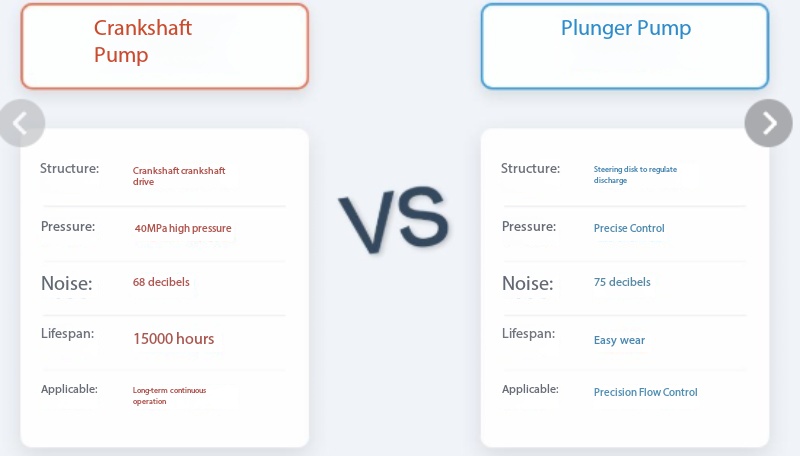
As a radial plunger pump crankshaft pump, in the 40MPa high pressure environment, the leakage is reduced by 40% than the swash plate pump, the pressure bearing capacity is stronger, and the flow attenuation rate is low (flow attenuation is only 5% for 8 hours).The plunger pump (especially axial) has less pressure fluctuations (± 0.2 MPa), suitable for situations where precise flow control is required.
Noise and Lifespan
The crankshaft pump produces a low frequency buzz (about 68 dB) when running, and the material uses 20CrMo journal with a life of more than 15,000 hours, which is twice that of ordinary 45 steel. The piston pump emits a high frequency scream (about 75 decibels), and long-term use is easily due to wear of the skis and the mating discs, resulting in insufficient pressure.
Applicable scenarios
Home Scenes
Ordinary car cleaning needs 80-100 bar pressure, SUV needs 100-120 bar, flow needs 6-10 L / min. The crankshaft pump has high stability, can clean multiple vehicles continuously and save water, and is suitable for high-frequency domestic use. The piston pump is low in cost, but it is easily heated during long-term use and is more suitable for low-frequency short-term cleaning.
Commercial and industrial scenarios
Car wash shops, farms, etc. need long continuous operations (such as washing more than a dozen cars continuously), and the durability and temperature control advantages of crankshaft pumps are significant, and can be adapted to 220V / 380V voltage to meet industrial electricity demand.Precision industrial cleaning (such as optical lenses) requires precise pressure control of the cylinder pump (flow pulse low to 0.03, concentration fluctuation ± 1%).
Maintenance Cost and Lifetime
Initial inputs
Due to the high manufacturing cost, the initial investment is about 1.8 times that of the piston pump, but the long-term cost-effectiveness is better. The initial cost of the piston pump is low and is suitable for household scenarios with limited budgets.
Long-term maintenance
The crankshaft pump has a complex structure but few fragile parts, and the five-year maintenance cost is only 60% of the initial cost (mainly replacement of bearings, seals, valve plates). There is no need to dismantle the cylinder when repairing. The cylinder pump maintenance requires the dismantling of the cylinder (e.g., ski boots, distribution plate replacement), the distribution valve of the three-cylinder pump is fragile (e. g., 8 seals are changed daily in mines). Although the ceramic cylinder pump is more durable in high sand content, the replacement cycle is still shorter than the crankshaft pump.